

Sarcoma is a rare form of cancer that develops in the bones or soft tissues, such as muscles, fatty tissue, and blood vessels. This disease can affect people of all ages, but it is often diagnosed later in life.
What is a sarcoma?
A sarcoma is a malignant tumor that develops from connective tissue. It can occur in bones, muscles, adipose tissue, tendons, blood vessel walls, or other soft tissues. Unlike other forms of cancer, such as carcinomas, which originate from epithelial tissue, sarcomas are connective in origin. This distinguishes them from other tumors both biologically and clinically.
The development of sarcoma is rare, accounting for only a small fraction of all cancer cases. Its rarity makes diagnosis difficult, as symptoms can resemble other diseases. The biological diversity of sarcoma means that each case is unique and requires an individualized approach.
Types of bone and soft tissue sarcoma
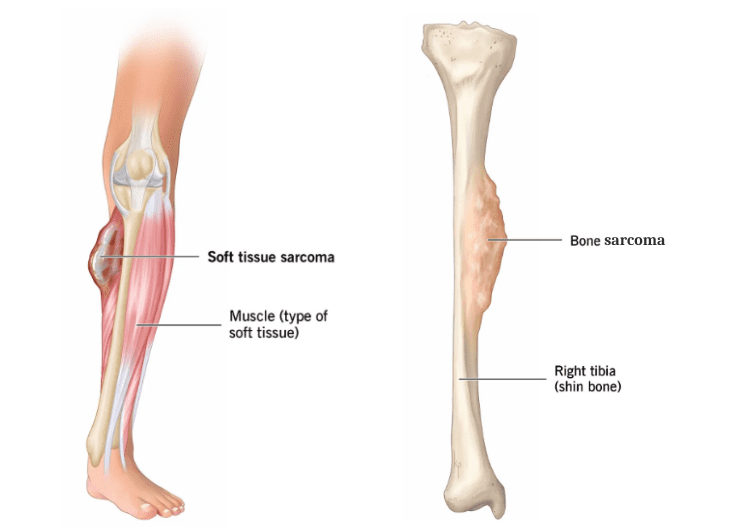
Sarcomas are divided into two main categories: bone sarcomas and soft tissue sarcomas. These types differ in origin, incidence, and symptoms. Both require a specific approach in diagnosis and treatment.
Soft tissue sarcomas
Soft tissue sarcomas occur in muscles, adipose tissue, tendons, blood vessel walls, or other soft tissues. Soft tissue sarcomas and intermediate-grade connective tissue tumors are rare, with an incidence of about 4–9 per 100,000 people per year in Europe (Rothermundt, 2023). The most common types are liposarcoma and leiomyosarcoma. Liposarcoma develops in fatty tissue and can occur in various parts of the body, including the abdominal cavity and limbs. Leiomyosarcoma affects smooth muscle tissue, such as the walls of the gastrointestinal tract or blood vessels.
Soft tissue sarcomas can go unnoticed for a long time as they do not always cause pain. However, as the tumor grows, it may compress surrounding tissues and organs, causing discomfort or functional impairments. Soft tissue sarcomas are rare, but their diversity makes diagnosis challenging. Accurate histological analysis is important to determine the tumor type and select appropriate treatment.
Bone sarcomas
Bone sarcomas are malignant tumors that develop in bone tissue. They occur even more rarely than soft tissue sarcomas, with an overall incidence ranging from 0.8 to 0.9 cases per 100,000 people per year (Strauss et al., 2021). The most frequently occurring are osteosarcoma and Ewing sarcoma. Osteosarcoma mainly affects adolescents and young adults, as it often develops during periods of rapid bone growth. It typically occurs in the knee or shoulder area. Ewing sarcoma, which is also common in younger people, can develop in both bones and soft tissues. It frequently occurs in the area of the pelvis, femur, or ribs.
Bone sarcomas often cause severe pain and swelling in the affected area. In some cases, bone fractures may occur without significant trauma. Early diagnosis is critical, as bone sarcomas can rapidly spread, or metastasize, to other parts of the body, including the lungs.
Source: Oncoplus
Risk factors
It is not always possible to determine the exact causes of sarcoma, but researchers have identified several risk factors that may increase the likelihood of developing this rare cancer.
Genetic mutations and hereditary predisposition
Certain genetic syndromes, such as Li-Fraumeni syndrome and retinoblastoma gene mutations, are associated with an increased risk of sarcoma. Familial predisposition may also play a significant role.Radiation
Previous exposure to radiation therapy, especially with a high radiation dose, can increase the risk of developing sarcoma. This is particularly true for patients who have received radiation therapy for other types of cancer.Chemical exposures
Exposure to certain chemicals, such as herbicides and vinyl chloride, may increase the risk of soft tissue sarcoma. These substances can damage cells and promote the development of mutations.Chronic inflammatory conditions
Long-term inflammatory conditions or chronic injuries may in certain cases promote the development of sarcoma. For example, Paget's disease, which affects the bones, is associated with an increased risk of bone sarcoma.
Symptoms
Symptoms of sarcoma can vary depending on the type, location, and size of the tumor. Early detection of symptoms is important to prevent the disease from spreading to other parts of the body. Below are the main symptoms frequently occurring in sarcoma patients.
Pain and swelling in the affected area
Pain is one of the first symptoms that sarcoma patients experience. It usually occurs due to tumor pressure on surrounding tissues and nerves. The pain may be mild at first, but becomes more intense over time. In addition to pain, swelling may develop in the affected area, which is often noticeable and tender to the touch. For example, in the case of bone sarcoma, swelling may occur in the knee or shoulder area, while soft tissue sarcoma can cause swelling in the limbs or abdominal cavity.
Mobility difficulties and loss of function
When sarcoma affects joints, muscles, or bones, it can cause difficulty moving. A person may find it challenging to perform daily activities, such as walking or lifting heavy objects. In some cases, the tumor may cause partial or complete loss of limb function. For example, if the tumor compresses nerves or blood vessels, it can cause numbness, weakness, or even paralysis in the affected area.
General symptoms
In addition to localized pain and difficulty moving, sarcoma can also be accompanied by general symptoms. These include fatigue, weight loss, and fever. Some patients may also notice a decrease in appetite. These symptoms often indicate that the disease has reached an advanced stage. Although these symptoms are not specific to sarcoma alone, they should be reason enough to consult a doctor.
Diagnostic options
Diagnosing sarcoma requires a thorough and multi-step approach to accurately determine the type, location, and extent of the tumor. Doctors use various methods to gather the necessary information and develop an appropriate treatment plan.
Clinical evaluation
Diagnosis usually begins with a review of the patient's medical history and symptoms. The doctor examines the affected area, looking for swelling, pain, or other unusual changes. A physical examination helps identify the potential location and size of the tumor.Image diagnostics
Imaging technologies play an important role in the diagnosis of sarcoma. X-ray, computed tomography (CT), and magnetic resonance imaging (MRI) allow doctors to see the exact location and extent of the tumor. Positron emission tomography (PET) helps evaluate whether the tumor has spread to other parts of the body.Biopsy
During this procedure, a small tissue sample is taken and analyzed under a microscope. Histological examination makes it possible to determine the type of tumor and the degree of malignancy. Biopsy results are essential in order to select the most effective treatment method.Cancer tests
Unlike traditional single-cancer screening, it is possible to detect multiple cancer types using a simple blood test. This method can detect tumors that may go unnoticed by current technologies. The method analyzes circulating tumor cells (CTCs) to determine the molecular imprint of the tumor's origin and mass, which helps to precisely define the tumor's tissue or organ. This precision allows for targeted further research and reduces the risk of diagnostic error.
Early detection of sarcoma plays a vital role in treatment success. The earlier the disease is diagnosed, the greater the chance of effective treatment and maintaining quality of life. Treatment and prognosis depend largely on the type of tumor, its location, and the stage of the disease at the time of diagnosis.